
 Joyce
Joyce 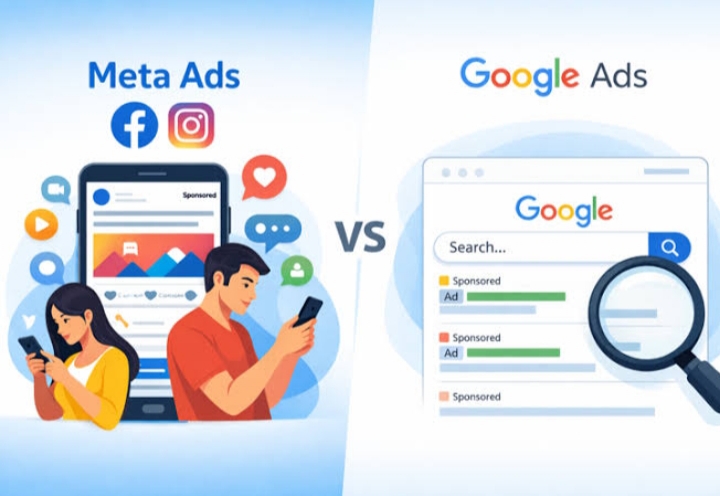
For small businesses trying to grow online, one of the biggest marketing decisions is choosing between Meta Ads and Google Ads.
Both platforms are highly effective, but they operate in completely different ways.
The best option depends on factors such as:
- Your type of business
- Your advertising budget
- Your target customers
- Your sales goals
- Whether you want to build awareness or capture ready-to-buy customers
Understanding the Main Difference
Meta Ads
Meta Ads appear across platforms like:
- Messenger
- Audience Network
These ads are designed around discovery.
Users are usually scrolling through content rather than actively searching for a product or service. Meta relies heavily on interests, online behavior, demographics, and visual content to reach potential customers.
Google Ads
Google Ads appear on:
- Google Search
- YouTube
- Gmail
- Google Display Network
Google works differently because it targets search intent.
People using Google are actively looking for solutions, services, or products. This often means they are closer to making a buying decision.
A Simple Comparison
| Feature | Meta Ads | Google Ads |
|---|---|---|
| User Intent | Lower intent | Higher intent |
| Best Use | Awareness & engagement | Leads & direct sales |
| Targeting Method | Interests & behaviors | Keywords & searches |
| Ad Style | Visual & social content | Search & display ads |
| Average CPC | Usually lower | Often higher |
| Conversion Speed | Slower customer journey | Faster conversions |
| Creative Importance | Very high | Moderate |
| Ideal for Small Budgets | Strong for testing | Better for high-intent campaigns |
When Meta Ads Are More Effective
Meta Ads perform well for businesses that rely on:
- Strong visuals
- Emotional buying decisions
- Brand awareness
- Community engagement
- Impulse purchases
Businesses that benefit most from Meta Ads:
- Fashion brands
- Beauty businesses
- Restaurants
- Fitness companies
- Coaches and creators
- Lifestyle brands
- E-commerce stores
Meta is especially effective when storytelling and visual content influence customer decisions.
Benefits of Meta Ads
- Lower advertising costs in many industries
- Detailed audience targeting
- Powerful retargeting options
- Excellent for video marketing
- Strong brand-building potential
Downsides
- Lower purchase intent
- Creative quality matters heavily
- Performance can fluctuate
- Tracking conversions may sometimes be inconsistent
Many marketers describe Meta as a “demand generation” platform because it introduces products to people who were not actively searching for them.
When Google Ads Perform Better
Google Ads are ideal for businesses offering services people already need.
Businesses that benefit most from Google Ads:
- Plumbing services
- Law firms
- Dental clinics
- Real estate businesses
- Repair services
- SaaS products
- Local service providers
For example, when someone searches:
- “Best bakery near me”
- “Emergency electrician”
- “Affordable accountant”
That person already has intent to buy or hire.
Google helps businesses capture that demand immediately.
Benefits of Google Ads
- Higher conversion intent
- Faster lead generation
- Excellent for local searches
- Strong keyword targeting
- Effective for urgent services
Downsides
- Higher cost-per-click in competitive markets
- Requires keyword research and optimization
- Smaller businesses may struggle against larger advertisers
Which Platform Should Small Businesses Choose?
There is no single answer because both platforms serve different purposes.
Choose Meta Ads if:
- You want to increase brand awareness
- Your products are visually appealing
- You have a limited budget
- You want to grow an audience
- Your customers buy emotionally
Choose Google Ads if:
- You want immediate leads or sales
- Customers already search for your service
- You provide problem-solving or urgent services
- Your goal is direct conversion
Why Using Both Platforms Often Works Best
Many businesses achieve stronger results by combining both platforms instead of relying on just one.
A common customer journey looks like this:
- Someone discovers your brand on Instagram or Facebook
- They become interested
- Later, they search for your business on Google
- They compare reviews and information
- They make a purchase or inquiry
In this process:
- Meta builds awareness
- Google captures intent
Together, they create a more complete marketing funnel.
Budget Advice for Beginners
For service-based businesses:
Start with Google Ads and focus on:
- High-intent keywords
- Local targeting
- Conversion-focused campaigns
For product-based businesses:
Start with Meta Ads and focus on:
- Video content
- Strong visuals
- Retargeting campaigns
If your budget allows both:
A balanced approach could be:
- 60% on Google Ads
- 40% on Meta Ads
Or:
- Meta for awareness
- Google for conversions and retargeting
Final Thoughts
Meta Ads and Google Ads are not direct replacements for each other.
They solve different marketing challenges.
- Google Ads capture people already searching for solutions.
- Meta Ads introduce your business to new audiences.
For small businesses:
- Google often delivers faster conversions.
- Meta often delivers broader reach and cheaper visibility.
The most successful brands usually combine both platforms to build awareness while also converting high-intent customers.