
 Joyce
Joyce 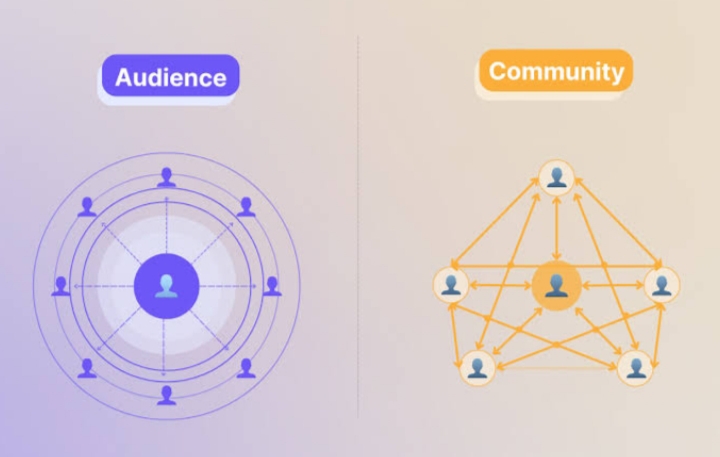
In today’s digital landscape, the words “community” and “audience” are often treated as if they mean the same thing. However, they represent two very different forms of online growth.
An audience consists of people who watch, read, or consume your content.
A community consists of people who actively connect with you and with one another.
The distinction has become even more important in 2026 as algorithms continue to shape online visibility and competition for attention grows stronger. Many creators and brands are realizing that large follower counts do not automatically create loyalty, trust, or lasting influence.
Building an audience increases visibility.
Building a community creates deeper relationships.
Understanding Audience Building
Audience building is mainly focused on attracting attention and expanding reach.
People follow creators because they enjoy their content, find value in their ideas, or are entertained by what they share. Social media platforms are designed to reward visibility, making it possible for creators to grow audiences quickly through viral content, trends, and algorithm-driven exposure.
Audience growth is commonly measured through:
- Followers
- Views
- Reach
- Likes
- Impressions
- Engagement rates
In most cases, the relationship is one-sided:
The creator publishes content, and the audience consumes it.
Platforms such as TikTok, Instagram, YouTube, and X make audience growth easier than ever before.
However, audiences can also be unpredictable and temporary.
Since many audience relationships are based mainly on content consumption, attention can disappear quickly when:
- Algorithms change
- Trends lose momentum
- Posting frequency decreases
- New creators emerge
Someone may enjoy your content without feeling personally connected to your brand or mission.
Understanding Community Building
Community building focuses on creating belonging rather than simply gaining attention.
A community is built through interaction, participation, and shared identity. Members are not only connected to the creator but also to each other.
Unlike audiences, communities are based on relationships.
Community growth often emphasizes:
- Trust
- Loyalty
- Conversation
- Participation
- Shared values
- Long-term engagement
- Emotional connection
People remain active in communities because they feel involved, understood, and connected.
Communities often grow within:
- Discord groups
- Facebook Groups
- Reddit forums
- Telegram channels
- Slack workspaces
- Membership platforms
- Private online spaces
At the same time, communities can also form naturally through comment sections, livestreams, newsletters, and recurring discussions.
Attention vs Connection
The main difference between an audience and a community comes down to one core idea:
Audiences are built on attention.
Communities are built on connection.
Someone in your audience may regularly view your content.
Someone in your community is more likely to support your work consistently, recommend you to others, engage in conversations, and remain loyal over time.
Audiences consume content.
Communities participate in it.
Why Community Matters More in 2026
As social media platforms become increasingly dependent on algorithms, creators face less control over their reach and visibility.
A creator may have millions of followers yet still experience declining engagement if a platform changes its recommendation system.
Communities provide more stability because strong relationships are not entirely dependent on algorithms.
People who feel genuinely connected are more likely to:
- Search for your content directly
- Subscribe to newsletters
- Join private groups
- Support paid memberships
- Participate regularly
- Stay loyal long-term
This shift explains why many modern creators and brands are investing more heavily in community-building strategies.
Audience Growth Is Faster
Building an audience is generally easier and quicker than building a community.
A viral post can attract thousands or even millions of viewers within a short period of time.
Community growth, however, takes patience because trust cannot be built instantly.
Strong communities develop gradually through:
- Consistency
- Honest interaction
- Shared experiences
- Valuable discussions
- Responsiveness
- Long-term relationship building
Audience growth is often driven by exposure.
Community growth is driven by trust.
Successful Brands Build Both
The most effective creators understand that audiences and communities serve different purposes.
An audience helps expand awareness and attract new people.
A community strengthens loyalty and creates deeper engagement.
For example:
- A creator may gain an audience through YouTube videos.
- A private Discord group may transform that audience into a community.
- A newsletter may deepen trust.
- Livestreams and events may encourage participation.
The audience creates visibility.
The community creates belonging.
Signs You Have an Audience Instead of a Community
Many creators assume they have a community when they mainly have viewers or followers.
Common signs include:
- High view counts with limited interaction
- Low audience participation
- Weak loyalty
- Minimal direct conversations
- Declining engagement after trends end
- Followers who rarely return consistently
If people only consume content passively, the connection may still be audience-based rather than community-driven.
Signs of a Strong Community
Healthy communities often display recognizable behaviors:
- Members interact with one another regularly
- Conversations continue without the creator’s involvement
- People return consistently
- Members recommend the group organically
- Shared culture and inside jokes develop
- Followers feel emotionally invested
At this point, the creator becomes more than just a content producer.
They become a trusted figure within a shared space.
The Future of Online Growth
The internet is becoming increasingly crowded with content, making genuine connection more valuable than ever.
Attention is temporary.
Relationships last longer.
Creators who focus only on views and follower counts may continue growing quickly, but those who prioritize meaningful engagement are more likely to build lasting influence and stability.
In 2026, long-term success online is not only about attracting an audience.
It is about creating a community where people feel connected, valued, and involved.